

kjamrvpsv@gmail.com
+919447535633
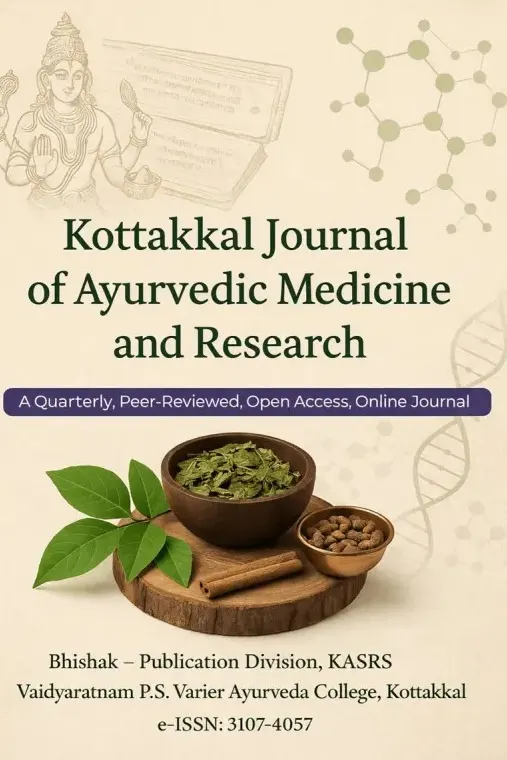
e-ISSN: 3107-4057
logo

Kottakkal Journal of Ayurvedic Medicine And Research

Kottakkal Journal of Ayurvedic Medicine And Research

Advancing knowledge through rigorous peer-reviewed research across multiple disciplines. Join the global community of scholars shaping the future of academic discovery.

📢 Latest Update: Call for papers for the July–August 2026 issue – Submit by May 31, 2026.

📢 Latest Update: Call for papers for the July–August 2026 issue – Submit by May 31, 2026.

Important Journal Details

Title:
Kottakkal Journal of Ayurvedic Medicine And Research
Journal Short Name:
KJAMR
e-ISSN (Online):
3107-4057
Year of Establishment:
2025
Frequency of the Publication:
Quarterly (4 Issues / year)
Publication Format:
Online
Publication URL:
https://kjamrvpsv.org
Related Subject:
Ayurvedic MedicineResearch
Language:
English
Editor-in-Chief:
Dr. Bindu KK
Editorial Board:
Click Here →
Journal's Email ID:
kjamrvpsv@gmail.com

Download Forms & Formats

Download Hub

Publisher Details

Responsible Person Name:
Sri. Neelakandan A. N.
Name of Publishing body:
Bhishak Publication Division, Kerala Ayurvedic Studies and Research Society
Publisher Website Url:
https://kasrs.org/kasrs/index.php
Address:
Chief Executive Officer, Kerala Ayurvedic Studies and Research Society, Kottakkal, Kerala, 676501

Journal Features

Rigorous Peer Review

All submissions undergo thorough evaluation by experts in the field to ensure quality and validity.

Global Reach

Published papers reach an international audience of researchers, academics, and industry professionals.

Rapid Publication

Efficient review process ensures timely publication of accepted papers without compromising quality.

Open Access

All published papers are freely accessible online, maximizing visibility and impact of your research.

Publication Process

1

Prepare Manuscript

Format your paper according to our guidelines

View Guidelines
style="fill: var(--journal-600);"
2

Submit Paper

Upload your manuscript through our system

Submit Now
3

Peer Review

Your paper undergoes expert evaluation

Learn More
4

Publication

Accepted papers are published worldwide

View Publications
View All Issues
Cover image for EXAMINING THE EFFICACY OF AYURVEDIC THERAPIES IN SELECTED CLINICAL CONDITIONS REFERRED FOR SURGICAL INTERVENTION: A CROSS-SECTIONAL RETROSPECTIVE COMPARATIVE STUDY

EXAMINING THE EFFICACY OF AYURVEDIC THERAPIES IN SELECTED CLINICAL CONDITIONS REFERRED FOR SURGICAL INTERVENTION: A CROSS-SECTIONAL RETROSPECTIVE COMPARATIVE STUDY

Dr Dinesh Karayil Subramanian, Dr Deepty Nair, Dr Smitha Kandathil Karthikeyan, Dr Geethu Balakrishnan

Background: While conventional medicine often mandates surgical intervention for various structural and inflammatory pathologies, a significant patient cohort seeks Ayurvedic alternatives due to personal preference, cost constraints or surgical contraindications. This study evaluates the long-term clinical outcomes of patients who opted for Ayurvedic management despite being formally advised to undergo surgery. Methods: A retrospective analysis was conducted on 8,012 case records from three Ayurvedic centres in Kerala, India, spanning a ten-year period (January 2006 to December 2015). A total of 1,174 patients met the inclusion criteria, having sought Ayurvedic care specifically to avoid recommended surgical procedures. Outcomes were categorized into five thematic domains: Surgery Totally Avoided, Improved Quality of Life (QoL) without Surgery, Deterioration due to Surgical Delay, resolved via Surgery and Lost to Follow-up. Results: The data revealed that 76.06% (n=893) of the study population successfully avoided surgery, while an additional 15.08% reported significantly improved day-to-day functioning without operative intervention. Clinical success was particularly notable in cases of intervertebral disc prolapse (IVDP) and acute appendicitis. Conversely, a small minority experienced a decline in health status attributed to the postponement of necessary surgical care. Conclusion: These findings suggest that Ayurvedic protocols can serve as a viable alternative to surgery for specific conditions, particularly where "preference-sensitive" decisions are involved. The high rate of surgery avoidance and improved functional outcomes underscore the need for an integrative healthcare model. Further prospective research is warranted to standardize these non-operative Ayurvedic pathways within mainstream surgical triaging.

Cover image for AYURVEDIC INTERPRETATION OF HYPERTENSION: AN EIGHTFOLD SAMPRAPTI FRAME WORK

AYURVEDIC INTERPRETATION OF HYPERTENSION: AN EIGHTFOLD SAMPRAPTI FRAME WORK

Dr Neethu K

Introduction Hypertension, commonly known as high blood pressure, is one of the most prevalent lifestyle disorders of the modern era. It is often referred to as a “silent killer”9 because it usually remains asymptomatic until serious complications arise. The increasing incidence of hypertension in recent decades highlights its global significance and its strong association with cardiovascular, renal, and cerebrovascular diseases. From an Ayurvedic perspective, hypertension can be understood through the concepts of Dosha, Dushya, Srotas, and Samprapti. This article aims to explore the Ayurvedic understanding of hypertension by correlating modern clinical features with Ayurvedic principles. Furthermore, eight possible Samprapti (pathogenetic mechanisms) have been postulated based on collected data and observations, providing an integrative view that bridges classical Ayurvedic knowledge and contemporary medical understanding. Methods of study This study is primarily conceptual in nature and is based on a comprehensive review and correlation approach. Relevant Ayurvedic and modern literature was critically analysed to understand the pathogenesis (Samprapti) of hypertension from both perspectives. The Ayurvedic texts including Charaka Samhita, Sushruta Samhita, Ashtanga Hridaya, Ashtanga Samgraha and their commentaries were reviewed to collect references related to Vata, Pitta, Kapha, Rakta, Srotodushti, Avarana and Manasika Nidanas. Modern medical textbooks and scientific articles were referred to identify clinical features, etiological factors, and pathological mechanisms of hypertension. By correlating these findings, eight possible Samprapti pathways were postulated, integrating modern clinical observations with Ayurvedic pathophysiological concepts. Each proposed Samprapti was analysed with respect to Dosha, Dushya, Srotas, Agni, Srotodushti Lakshana, Udbhavasthana and Adhistana to provide a comprehensive understanding.

Cover image for ASSESSMENT OF DHATU SARATA USING C-DAC AYUSOFT: SCOPE AND CHALLENGES

ASSESSMENT OF DHATU SARATA USING C-DAC AYUSOFT: SCOPE AND CHALLENGES

Dr Mursida P, Dr Anandalakshmy K N

Introduction and Background: Measurement is essential in scientific research, yet Ayurveda has often overlooked its importance, relying on qualitative and subjective assessments. In the era of evidence-based medicine, the lack of scientific tools for health measurements hinders the progress of Ayurveda. Dhatu Sara, the purest form of the Dhatu, serves as a key indicator for assessing an individual’s strength. The assessment of Dhatu Sara lacks validated and reliable tools. Most available methods are subjective and rely on individual measurements, limiting their utility. AyuSoft, developed by C DAC, Pune, provides a standardized, computer-based tool for assessing Dhatu Sara, which is widely in use nowadays. This study critically reviews the Ayusoft Dhatu Sara assessment tool, focusing on the challenges faced during its practical application. It aims to identify and recommend necessary updates to enhance its usability and relevance for users. Methods: The Ayusoft software was procured from C-DAC, Pune and installed on a computer. It was then used to assess the Dhatu Sarata of 50 individuals. Both the benefits and challenges encountered during the use of the software were thoroughly documented. Results: The tool proved user-friendly, and integrating the Dhatu Sara assessment into software provides a convenient, portable solution for clinical use, removing the need for manual data analysis. However, its time-consuming nature and reliance on a highly subjective questionnaire posed challenges for routine clinical use. Conclusion: The findings suggest that while AyuSoft is a promising step toward standardized Dhatu Sara evaluation, further refinements are necessary to enhance its accuracy, reliability, and practical utility in clinical settings by incorporating both user and patient perspectives.

Publication Process

Learn about our 4-step publication process

Submission Guidelines

Review requirements before submitting

Submit Article

Ready to submit your research?

36
Published Articles
86
Active Researchers
246
Countries
N/A
Impact Factor